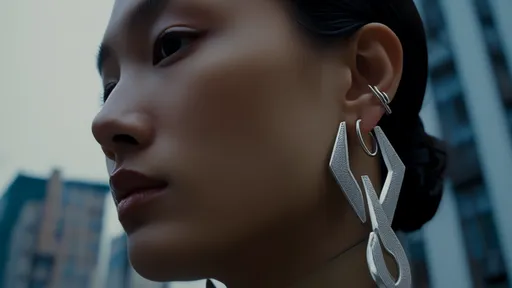
The fashion world thrives on contrasts, and nowhere is this more evident than in the current jewelry trend that pits microscopic earrings against gargantuan statement pieces. This radical polarization in earring sizes creates a visual tension that designers are exploiting to make bold artistic statements. What began as subtle experimentation on avant-garde runways has now trickled down to mainstream accessory collections, challenging conventional notions of proportion and wearability.
The rise of ultra-miniature earrings represents a fascinating counter-movement to decades of increasingly larger jewelry designs. These barely-there studs, some no larger than a pinhead, require observers to lean in uncomfortably close – creating an intimate viewing experience that borders on voyeurism. Luxury houses craft these minuscule pieces from unexpected materials: diamond dust suspended in transparent resin, platinum filaments thinner than eyelashes, or single droplets of colored liquid trapped beneath sapphire glass. The technical precision required to manufacture such tiny wearable art often surpasses that needed for traditional jewelry, with master craftsmen using microscopic lenses and surgical tools during production.
At the opposite extreme, architectural ear pieces now cascade down necks, brush against collarbones, and sometimes even require structural support systems hidden in hairstyles. These wearable sculptures incorporate industrial materials like titanium mesh, acrylic panels, and even LED components that transform ears into kinetic art installations. The weight distribution challenges have sparked innovations in ergonomic backing systems and lightweight composite materials originally developed for aerospace applications. Some designs intentionally play with discomfort, forcing wearers to move with deliberate grace to accommodate their jewelry's physical demands.
The cultural implications of this size dichotomy reveal much about contemporary fashion psychology. Miniature earrings appeal to those embracing stealth wealth aesthetics and minimalist philosophies, where luxury whispers rather than shouts. The subtlety becomes a private pleasure known only to the wearer and their most intimate companions. Conversely, oversized earrings serve as armor-like declarations of identity, their sheer physical presence demanding acknowledgment in both digital and physical spaces. Social media has amplified this effect – while tiny studs disappear on camera, massive earrings gain new dimensionality through screen distortion and perspective tricks.
Materials science has become the unsung hero of this trend. Advanced metallurgy allows giant hoops to maintain structural integrity while weighing less than traditional medium-sized designs. Nanotechnology enables the creation of microscopic clasps that secure nearly invisible studs without compromising safety. Designers collaborate with engineers to push boundaries: one avant-garde collection featured earrings that changed size through temperature-sensitive shape-memory alloys, alternating between extremes throughout the day.
This polarization extends beyond aesthetics into functionality. The smallest earrings often incorporate practical elements like hidden trackers or medical sensors, their size belying sophisticated technology. Oversized counterparts frequently integrate utilitarian features – serving as Bluetooth receivers, air quality monitors, or even emergency toolkits with fold-out components. The intersection of form and function reaches new heights as jewelry becomes interface, transforming the human body into an interactive platform.
Historical precedents for both extremes exist across cultures, from the delicate pearl studs of European aristocracy to the massive wooden plugs worn by indigenous tribes. Contemporary designers reference these traditions while subverting expectations – a tribal-inspired piece might be recreated in fragile glass at miniature scale, or an Edwardian-style stud might be blown up to absurd proportions in lightweight aerogel. This cultural remixing creates dialogue between fashion eras and societies, with size serving as the primary vocabulary.
The styling challenges presented by these opposing trends have revolutionized accessorizing approaches. Fashion editors recommend pairing an enormous single earring with its microscopic counterpart on the other ear for dramatic asymmetry. Others suggest clusters of tiny studs surrounding one massive centerpiece, creating planetary systems around the lobe. Makeup artists have developed new techniques to complement each extreme: barely-there nude tones for miniature jewelry, or bold contouring that extends the visual line of statement pieces across the entire face and neck.
Economic factors surprisingly favor both ends of the spectrum. While massive earrings require more material, many utilize inexpensive substrates with luxurious finishes. Ultra-small pieces command premium prices despite minimal material costs due to their intricate craftsmanship. The market has responded with equal enthusiasm for both, creating parallel industries within jewelry manufacturing that rarely compete for the same consumer dollars.
Looking forward, this polarization shows no signs of reconciliation. If anything, the gap widens as technology enables more extreme interpretations at both ends. The next frontier may involve earrings that actively change size through mechanical or digital means, or designs that play with optical illusions to appear simultaneously large and small from different angles. One thing remains certain: in the world of ear adornments, moderation has become the most radical choice of all.
By /Aug 1, 2025
By /Aug 1, 2025

By /Aug 1, 2025

By /Aug 1, 2025

By /Aug 1, 2025
By /Aug 1, 2025

By /Aug 1, 2025
By /Aug 1, 2025
By /Aug 1, 2025

By /Aug 1, 2025

By /Aug 1, 2025

By /Aug 1, 2025

By /Aug 1, 2025

By /Aug 1, 2025

By /Aug 1, 2025

By /Aug 1, 2025

By /Aug 1, 2025
By /Aug 1, 2025
By /Aug 1, 2025

By /Aug 1, 2025
