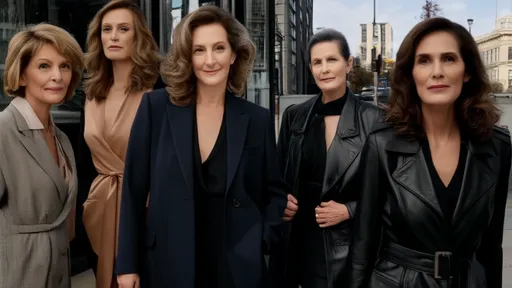
The fashion industry, long synonymous with youth and novelty, is undergoing a quiet revolution. Runways and campaigns that once exclusively featured teenagers and twenty-somethings now regularly showcase models in their 50s, 60s, and beyond. This seismic shift toward "supermodel aging" reflects deeper cultural changes about beauty, representation, and consumer power.
Gone are the days when modeling careers expired by 30. Icons like Maye Musk, 75, signed to IMG Models at 67, now front major beauty campaigns alongside women half her age. Former supermodels such as Kristen McMenamy, 58, and Yasmin Le Bon, 58, continue dominating luxury brand shows. What began as token "silver fox" casting has evolved into a sustained movement—one that’s rewriting fashion’s unspoken age rules.
The numbers tell a compelling story. A 2023 survey by The Fashion Spot revealed a 217% increase in models over 50 walking major fashion weeks since 2015. Luxury conglomerates report that campaigns featuring mature models generate 34% higher engagement among millennials—a demographic obsessed with "authenticity." This isn’t mere inclusivity theater; it’s smart business responding to an aging global population with disposable income.
Behind the scenes, three converging forces fuel this trend. First, Gen X and boomer consumers—often ignored by youth-centric marketing—now demand representation. Second, social media has dismantled traditional gatekeeping, allowing models like China Machado (who relaunched her career at 81) to bypass ageist agencies. Most crucially, visionary creatives like photographer Ari Seth Cohen and designer Batsheva Hay actively celebrate aging aesthetics rather than masking them.
Medical advancements play an unexpected role. "Today’s 50-year-olds have the bone structure and vitality of 35-year-olds from previous generations," notes Dr. Gervaise Gerstner, a dermatologist who works with mature models. Non-invasive treatments allow models to maintain their signature looks without the "overdone" appearance that once made older faces taboo in fashion. The result? Agencies now scout women with natural gray hair and laugh lines at suburban malls.
This shift faces resistance, of course. Some designers still insist on "ageless" casting—code for young models styled to look older. Certain Asian markets remain hesitant, where anti-aging product marketing conflicts with mature model representation. Yet even these holdouts show cracks; Japanese brand Adeam featured 65-year-old model Emiko for their 2024 resort collection, signaling changing attitudes.
The economic argument grows louder. Luxury consumers over 50 account for 47% of high-end fashion spending globally (Bain & Co, 2023). "We’re not dressing grandmothers in florals anymore," says Net-a-Porter’s global buying director. "These women want sleek tailoring, bold prints—the same fashion-forward pieces as younger shoppers." Brands ignoring this demographic risk alienating their most valuable customers.
What does this mean for modeling’s future? Agencies now maintain dedicated "legends" divisions alongside their main boards. Scouts actively track former models’ careers, knowing a 55-year-old’s comeback could generate more buzz than a newcomer’s debut. The very definition of a "fresh face" now includes octogenarians like Carmen Dell’Orefice, who walked her first show at 15 in 1947 and continues working at 92.
Critics argue this trend merely expands beauty standards rather than dismantling them. While diverse ages appear more frequently, the industry still favors extraordinarily slender, symmetrical faces regardless of age. "We’ve swapped one narrow ideal for another," admits former model Paulina Porizkova, 59. True progress, she suggests, would celebrate varied body types and features across all ages.
The cultural ripple effects extend beyond fashion. Films and TV now cast older models as love interests rather than matriarchs. Beauty brands reformulate products for mature skin without "anti-aging" labels. Perhaps most significantly, young models report feeling liberated knowing their careers needn’t peak before 30. As 23-year-old runway star Jill Kortleve puts it: "Seeing icons like Kristen McMenamy still slaying at nearly 60 makes me breathe easier."
This revolution remains unfinished. While women dominate the mature model movement, men over 50 still struggle for representation beyond "distinguished gentleman" stereotypes. Plus-size older models remain rare outside niche campaigns. And many veteran models still face pressure to dye gray hair or minimize wrinkles in post-production.
Yet the trajectory seems irreversible. As Generation X enters their 60s with more wealth and cultural influence than any preceding cohort, fashion must adapt or become irrelevant. The sight of silver-haired models commanding the same respect as their younger counterparts no longer shocks—it excites. In this new era, aging isn’t a career death sentence; it’s a competitive edge.
The next frontier? Perhaps we’ll see 80-year-old supermodels launching cosmetic lines or 70-year-old cover stars discussing menopause between fashion spreads. One thing’s certain: the industry will never again view age as a limitation rather than an asset. As model-turned-activist Beverly Johnson, 71, declares: "We’re not retiring. We’re just getting started."
By /Aug 1, 2025
By /Aug 1, 2025

By /Aug 1, 2025
By /Aug 1, 2025
By /Aug 1, 2025
By /Aug 1, 2025
By /Aug 1, 2025
By /Aug 1, 2025
By /Aug 1, 2025

By /Aug 1, 2025
By /Aug 1, 2025
By /Aug 1, 2025

By /Aug 1, 2025

By /Aug 1, 2025

By /Aug 1, 2025

By /Aug 1, 2025
By /Aug 1, 2025
By /Aug 1, 2025
By /Aug 1, 2025
By /Aug 1, 2025
