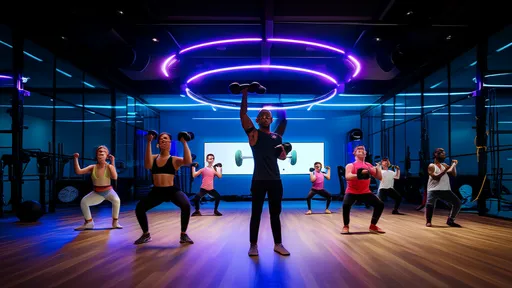
In the world of group fitness, synchronization is everything. The collective energy of a room moving as one creates an experience that transcends individual effort. But what happens when you introduce light as a metronome? When the very environment pulses in time with the movement? This is the emerging frontier of rhythm-based training, and it’s transforming how instructors and participants engage with group exercise.
The concept is deceptively simple: the lighting in a studio is programmed to change in sync with the beat of the music and the prescribed movements of the class. A well-timed flash on the downbeat of a squat, a slow fade during a hold, or a rapid pulse during a sprint interval—these visual cues work in concert with auditory ones to create a deeply immersive, almost hypnotic, training environment. It’s not just about seeing the beat; it’s about feeling the entire room breathe and move with you.
For instructors, mastering this technique is less about becoming a lighting technician and more about deepening their connection to musicality and cueing. The foundation is, and always will be, the music. Every track has its own architecture—its intro, verse, chorus, breakdown, and build. An instructor must know this structure intimately. Where is the crescendo? When does the kick drum drop? The lighting cues are mapped onto this existing musical roadmap. The light becomes an extension of the vocal cue, a physical manifestation of the rhythm that participants can see and feel in their periphery, reinforcing the timing and intensity of the movement.
The technology enabling this is increasingly accessible. Modern smart lighting systems can be integrated with music software or even controlled via MIDI controllers, allowing an instructor to trigger light changes as easily as they might change the volume. Simpler setups might use pre-programmed light shows synced to specific playlists. The key is consistency and intentionality. The changes shouldn’t be random or jarring; they must serve the purpose of enhancing the workout, not distracting from it. A sudden, blinding strobe during a complex balance sequence is a recipe for disaster, whereas a gentle, color-shifting wash during a warm-up can set a perfect mood.
The psychological impact on participants is profound. Humans are inherently rhythmic beings. Our heartbeats, our breathing, our gait—all operate on rhythms. By engaging another primary sense—vision—with a synchronized light show, you create a multi-sensory feedback loop that can boost motivation, improve timing, and even enhance performance. The light acts as a guide, pulling the entire class into a state of collective flow. It’s harder to slow down when the lights are pulsing faster; it’s easier to find the bottom of a lunge when a light dims at exactly the right moment. This external pacing can help participants push past mental barriers and achieve a higher level of synchronicity with the group.
Implementing this effectively requires careful planning. An instructor must choreograph not only the movement but also the light, treating it as another element of the performance. This often means creating a storyboard for the class: at minute five, as we transition into the first work block, the lights shift from blue to red and begin to pulse in time with the 130BPM track. It demands rehearsal, not just of the exercises, but of triggering the light cues at the precise moment. The goal is for the technology to feel seamless, an invisible hand guiding the experience rather than a flashy gimmick.
Ultimately, the synchronization of light, sound, and movement represents the evolution of group fitness from a purely physical pursuit to a holistic sensory experience. It’s about crafting moments—the collective gasp as the room plunges into darkness before a major drop in the music, the surge of energy as white light floods the room during the final all-out effort. These techniques forge a powerful emotional connection between the participants, the instructor, and the workout itself. It turns a routine class into an unforgettable event, proving that the future of fitness is not just about how we move, but about the world we create to move in.
By /Aug 25, 2025

By /Aug 25, 2025

By /Aug 25, 2025

By /Aug 25, 2025
By /Aug 25, 2025
By /Aug 25, 2025

By /Aug 14, 2025
By /Aug 25, 2025

By /Aug 14, 2025

By /Aug 25, 2025

By /Aug 25, 2025

By /Aug 25, 2025

By /Aug 25, 2025
By /Aug 25, 2025
By /Aug 25, 2025

By /Aug 25, 2025

By /Aug 25, 2025
By /Aug 25, 2025
By /Aug 25, 2025

By /Aug 25, 2025
