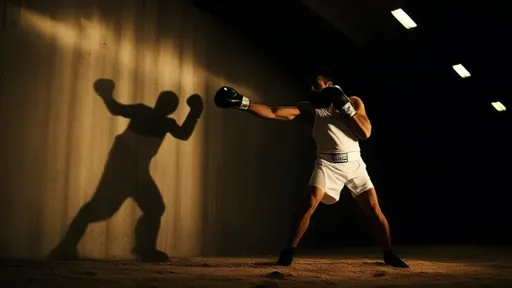
In the dimly lit training facility, a boxer moves with focused intensity, but it’s not the heavy bag or the sparring partner holding his attention. Instead, his eyes are fixed on the wall, tracing the sharp, exaggerated shadows cast by the overhead lights. Each jab, cross, hook, and uppercut is projected in real-time, a dynamic and unforgiving blueprint of his movement. This is shadowboxing, but not as most know it. This is an evolution, a method of using one’s own shadow as a high-definition feedback tool to diagnose and correct the most fundamental element of boxing: punch trajectory.
The concept is deceptively simple. For generations, fighters have used shadowboxing as a warm-up, a cool-down, or a way to mentally rehearse combinations. It’s often done with a glancing awareness of one’s reflection or shadow, but rarely with the intent of deep, technical analysis. The innovation lies in shifting that perspective—from moving *through* the shadow to actively *reading* it. The wall becomes a canvas, and the shadow a stark, honest critic of every micro-movement. There is no glove to cushion the impact, no bag to absorb poor form; there is only the pure, unadulterated line of the punch, drawn in light and darkness.
Why does trajectory matter so much? In the ring, efficiency is everything. A punch that travels in a straight line from point A (the guard) to point B (the target) is faster, stronger, and more energy-efficient than one that loops, dips, or wings out. A stray elbow, a dropped hand during retraction, or a wide, telegraphed arc doesn’t just waste energy—it creates openings for counters. Traditional training on bags and pads can mask these flaws. The feedback from hitting a solid object can make a sloppy punch *feel* powerful, confusing the sensation of impact with the quality of the technique leading to it. The shadow, however, offers no such deception. It shows the truth of the punch’s entire journey, from initiation to extension to return.
The process of correction begins with setup. The fighter positions themselves so that a single light source, ideally directly overhead or slightly behind, casts a crisp, defined shadow on a blank wall. The environment must be controlled; multiple light sources create fuzzy, overlapping shadows that are impossible to read. Once set, the boxer begins their work, throwing punches slowly and deliberately, their gaze locked not on their own fists but on the dark silhouettes mimicking their every move.
They are looking for specific, common flaws. A jab should shoot straight out and snap straight back, its shadow moving like a piston. Often, a fighter will see their shadow-jab dip downward before rising to the target, a wasteful scooping motion that robs the punch of speed and exposes the chin. A cross should drive straight from the chin, powered by a rotation of the hips and shoulders. The shadow might reveal that the elbow is flaring out, turning a powerful straight blow into a sluggish, arcing push. Hooks are particularly revealing. A proper hook maintains a tight, compact frame, the forearm parallel to the floor. The shadow often betrays a common error: the hand dropping well below the elbow during the wind-up, creating a massive "loop" that screams its intention to the opponent and takes an eternity to arrive.
The real magic happens in the retraction. A novice fighter pours all their attention into the extension, the moment of impact. A master knows the punch is not over until the hand is back home, guarding the face. The shadow is merciless in highlighting slow retractions. A hand that lingers out after a punch, its shadow suspended on the wall, is a hand not defending against the inevitable return fire. Watching the shadow forces the fighter to complete the entire action with purpose and speed, ingraining the rhythm of "snap out, snap back."
This method also provides unparalleled insight into body mechanics. The shadow connects the dots between the fist and the rest of the body. A fighter can see if their shoulder is rising unnaturally on a jab, tensing the neck and slowing the punch. They can observe whether their chin is jutting forward as they throw the cross, or if their feet are rooted and unable to drive force up through the legs and into the shadow-limb extending toward the wall. It becomes a full-body diagnostic tool, revealing the kinetic chain in its simplest, most visual form.
Beyond the physical corrections, training with the shadow builds a profound level of body awareness and focus. It demands a meditative concentration, a splitting of consciousness where the fighter must *feel* the movement in their muscles while simultaneously *observing* its external representation. This hones the mind-body connection to a razor's edge. In the chaos of a fight, when adrenaline blurs details, this deeply ingrained muscle memory and spatial awareness can be the difference between a glancing blow and a knockout punch.
Of course, the wall shadow is not a replacement for other training modalities. It is a supplement, a focusing lens. The insights gained against the wall must be pressure-tested on the heavy bag for power, on the focus mitts for accuracy and timing, and in sparring for tactical application. But it serves as the perfect first and last step of any training session. It is the place to drill perfect form without fatigue or resistance, and it is the place to cool down and reinforce those perfect patterns after the muscles are tired and the mind is tempted to get sloppy.
This technique is gaining traction in modern boxing gyms, moving from an obscure drill to a central part of technical development. Coaches are using smartphone cameras to record the shadows, allowing for frame-by-frame analysis with their fighters afterward. It’s a low-tech solution to a high-stakes problem, accessible to anyone with a light, a wall, and the will to improve. In a sport obsessed with new technology—from performance analytics to high-tech equipment—the oldest training partner of all, one’s own shadow, is proving to be one of the most insightful coaches a fighter can have.
In the end, boxing is a game of millimeters and milliseconds. The shortest distance between two points will always be a straight line. By turning to the wall and studying the silent, stark narrative of their shadow, fighters are learning to straighten their paths, tighten their arcs, and sharpen their weapons. They are learning to punch not just harder, but smarter. They are learning that the most honest reflection of their craft isn’t in a mirror, but in the dark silhouette dancing beside them, telling them everything they need to know.
By /Aug 25, 2025

By /Aug 25, 2025
By /Aug 25, 2025
By /Aug 25, 2025

By /Aug 25, 2025
By /Aug 25, 2025

By /Aug 14, 2025
By /Aug 25, 2025

By /Aug 14, 2025

By /Aug 25, 2025

By /Aug 25, 2025

By /Aug 25, 2025
By /Aug 25, 2025
By /Aug 25, 2025
By /Aug 25, 2025
By /Aug 25, 2025
By /Aug 25, 2025

By /Aug 25, 2025
By /Aug 25, 2025
By /Aug 25, 2025
